Press Voice ≠ Frank’s Voice
Direct quotations spoken by Frank remain in Voices of Frank. Reporter prose, columns and observations by other people belong here.
Press Story — Contemporary Reputation
The press record shows Frank’s reputation changing over time: a promising Kentucky lineman, a defensive mainstay and “shock trooper,” a Rams defender whose loss was noticed after a major trade, a Cardinals defensive captain, and finally a veteran whose last NFL chapter was recorded through transaction and injury reports.
How to Read This Room
This room preserves what newspapers, sportswriters and people quoted in newspaper coverage said about Frank. It does not turn those statements into Frank’s own voice, and it does not turn colorful praise into a formal award.
Direct quotations spoken by Frank remain in Voices of Frank. Reporter prose, columns and observations by other people belong here.
Words such as “mainstay,” “virtually indispensable” or “great defensive lineman” describe reputation. Selector-specific awards belong in the Awards Room.
When a game story praised Frank as part of a unit, this room does not rewrite that coverage as an individual statistic or solo achievement.
The visitor edition uses brief excerpts and original summaries. Full transcriptions remain research/archive material.
How the Press Saw Him — Thematic Reputation
Chronology shows when Frank’s reputation changed. These thematic clusters show what that reputation meant. Each card keeps newspaper assessment, quoted contemporary observation and team-publication context distinct rather than blending them into one modern verdict.
Newspaper assessment
By Frank’s senior season, Kentucky coverage had moved beyond prospect language. The press described a versatile veteran whose value was easy to miss precisely because he could be used wherever the line needed him.
“one of the most underrated performers”
The Kentucky Kernel • November 14, 1952
This is a contemporary evaluation, not a formal award or national ranking.
Team profile + contemporary testimony
The Rams record repeatedly emphasized Frank’s disruptive line play. A 1958 team profile called his Green Bay pass rush phenomenal and said it drew raves; later newspaper testimony remembered the force of his charge after Los Angeles traded him.
“phenomenal as a pass rusher”
Los Angeles Rams profile • 1958
The specific Green Bay praise is preserved in a Rams team publication, not presented here as an independent newspaper award.
Newspaper reporting + quoted team voice
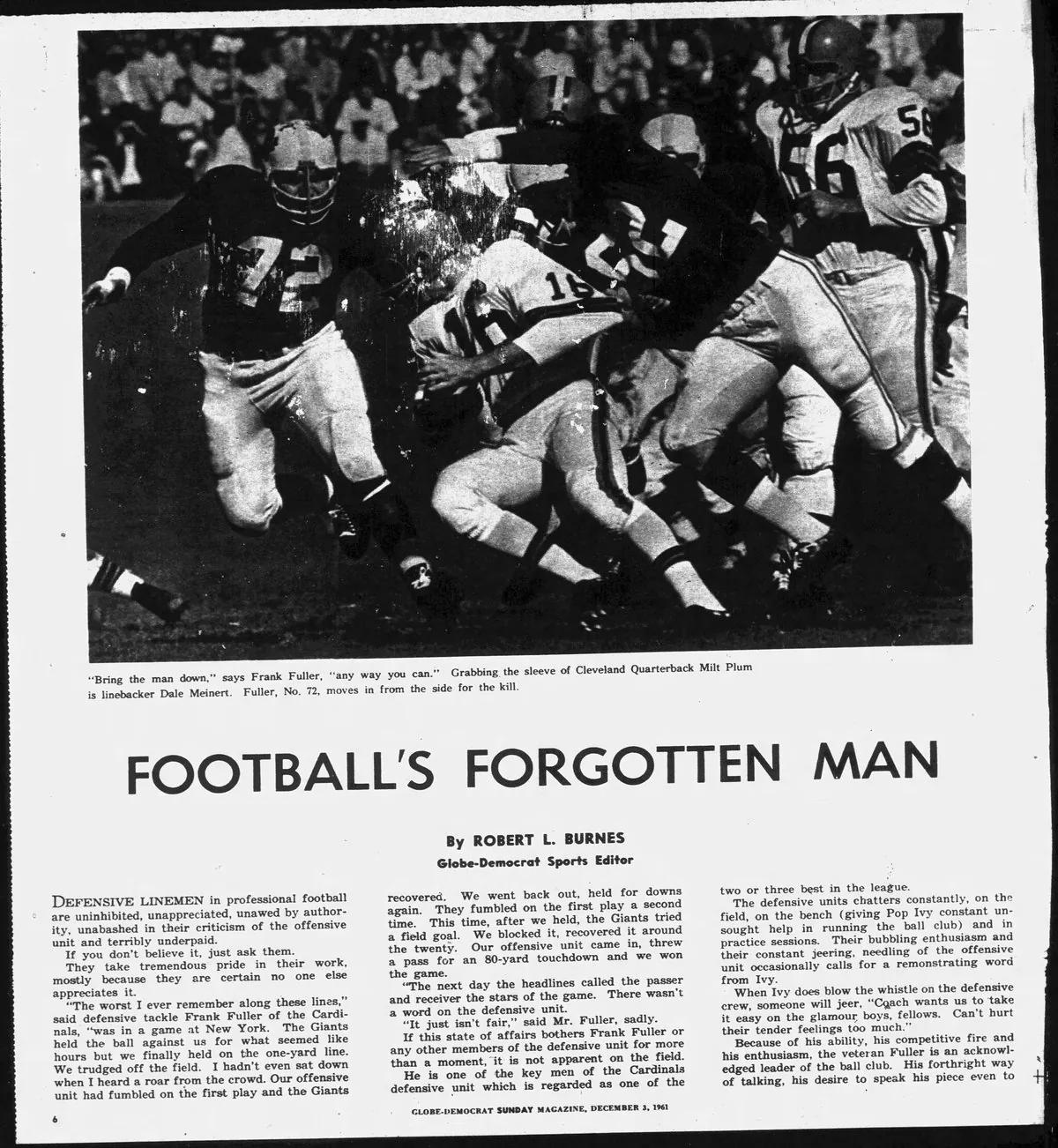
St. Louis coverage framed Frank as more than a veteran tackle. He was identified as the defensive captain, described as a player who keyed up the Cardinals, and credited by ownership with bringing added energy to daily practice.
“defensive captain”
St. Louis Post-Dispatch • 1961 coverage
Leadership language documents contemporary reputation and role; it does not create an additional formal honor.
Injury reporting
Injury became a recurring part of the press record without defining the whole career. Reports document a lost Rams season, a 1960 Cardinals fracture that weakened the defense, a determined 1961 return, and a final season-ending Eagles injury in 1963.
“hurting because of the loss”
St. Louis Post-Dispatch • November 27, 1960
The documented injuries remain separate events. The site does not merge anatomy or chronology beyond what each source supports.
Newspaper feature profile
The St. Louis features presented Frank as a player already building a second life. They documented insurance income, real-estate work, development activity and his role as head of Fuller Development Corporation in Los Angeles.
“insurance and real estate”
St. Louis Post-Dispatch • July 1961 features
The features establish the documented business activities; they do not supply complete corporate, ownership or financial records.
Associated Press wrestling coverage
The AP wrestling story gave the public a different Frank Fuller identity. It traced wrestling back to DuBois, noted post-1955 work in Kentucky and the Midwest, preserved the earlier “Kentucky Colonel” name and introduced the new billing.
“the battering Ram”
Associated Press • January 30, 1958
The article supports the billing and Frank’s public challenge to Leo Nomellini; by itself it does not prove that a later match occurred.
The same person could be described differently depending on the moment: overlooked in college, disruptive on the line, essential to team energy, recovering from injury, building a business future, or adopting a wrestling persona. The themes make those contemporary viewpoints visible without collapsing them into a single label.
Reputation Journey
Early Kentucky coverage presented Frank as a developing tackle with promise, then tracked his movement into other line roles.
By his senior year, the language had changed. Frank was described as an experienced defensive foundation, a versatile veteran and one of college football’s underrated performers.
After the Ollie Matson trade, newspaper coverage described Frank as one of the tackles Los Angeles had to replace and recorded unusually strong testimony about his value.
St. Louis coverage identified Frank as the defensive captain, documented how his injury affected the defense and portrayed his return as important to the team’s energy.
The surviving Eagles-era newspaper record is narrower and more factual: a veteran defensive tackle acquired from St. Louis, then lost for the season to another broken leg.
Reputation Evolution — At a Glance
Kentucky Press — 1949–1952
Kentucky coverage offers the clearest reputation progression in the archive. Frank moves from a player who had shown promise to a veteran who was central to the defensive line.
The spring-practice report places Frank at the beginning of his college development rather than treating him as an established star from the start.
Frank was one of four Kentucky players named in the collective praise after the 20–7 Cotton Bowl victory over TCU.
The Player of the Week feature identified Frank as Kentucky’s experienced defensive-tackle foundation during the Texas A&M game.
The same profile called Frank Kentucky’s top defensive player and explained the “shock trooper” identity through his willingness to fill the position most needed.
Rams Press — 1959 Departure
The team’s own guides document Frank’s development, but this room stays newspaper-centered. The most revealing newspaper evidence comes after Los Angeles sent him to Chicago in the Ollie Matson trade.
Rams co-captain Will Sherman grouped Frank with Ken Panfil as two tackles the club now had to replace.
Sportswriter Hank Hollingworth used unusually strong language when asking whether the Rams missed Frank after the trade.
John Olszewski’s comment was preserved inside the newspaper coverage. It is a quoted observation about Frank, not reporter prose and not a formal honor.
Cardinals Press — 1960–1961
St. Louis coverage is the richest professional press cluster in the archive. It records Frank not only as a defensive lineman, but as a captain whose absence, return and personality were treated as part of the team story.
The injury report did more than note a broken leg: it explicitly connected Frank’s absence to a weakened defensive unit.
The same short item recorded that he became sick to his stomach hours before games, preserving an unusually personal picture of a veteran captain’s pregame nerves.
Broeg’s feature framed Frank as a Pennsylvanian whose football opportunity led to Kentucky and whose professional identity had been built through sustained effort.
The training-camp feature tied Frank’s return to leadership, business ambitions and the energy surrounding the defense.
This is an owner observation preserved by the newspaper. It supports team influence, not an official leadership award beyond Frank’s separately documented captaincy.
Bob Broeg named Frank among the defenders closing on Washington quarterback Norman Snead during St. Louis’s 24–0 shutout, the club’s first since 1942.
Eagles Press — 1963
The surviving newspaper evidence for Philadelphia does not offer the same biographical depth or reputation language found in St. Louis. Rather than manufacture a narrative, this room preserves what the papers actually provide.
The transaction roundup reported Philadelphia acquiring Frank from St. Louis in exchange for guard John Wiltenborn.
By mid-October, the paper reported that Frank’s final NFL season had been ended by injury.
A second newspaper independently identified him as a defensive tackle and confirmed the season-ending injury.
Critical Separation
Newspapers could call Frank a mainstay, an underrated performer, a captain or even one of the league’s great defensive tackles. Those phrases matter historically, but they are not interchangeable with selector-specific honors.
Mainstay, shock trooper, virtually indispensable, hustle and hard work, team influence and other contemporary evaluations belong here.
Pro Bowl selection, Associated Press All-NFL Second Team, New York Daily News All-NFL Second Team and The Sporting News All-NFL First Team belong in the dedicated Awards Room.
Source Trail
Spring development, game reports, Player of the Week coverage and the 1952 “shock trooper” profile.
Cotton Bowl defensive praise and other Kentucky-era coverage.
1959 trade and Rams replacement coverage.
Post-trade Rams reputation coverage and contemporary testimony about Frank’s line play.
The deepest professional cluster: injury, captaincy, recovery, personality, business interests and defensive-game context.
1963 Philadelphia acquisition and season-ending injury coverage.
Evidence Control
Continue Exploring